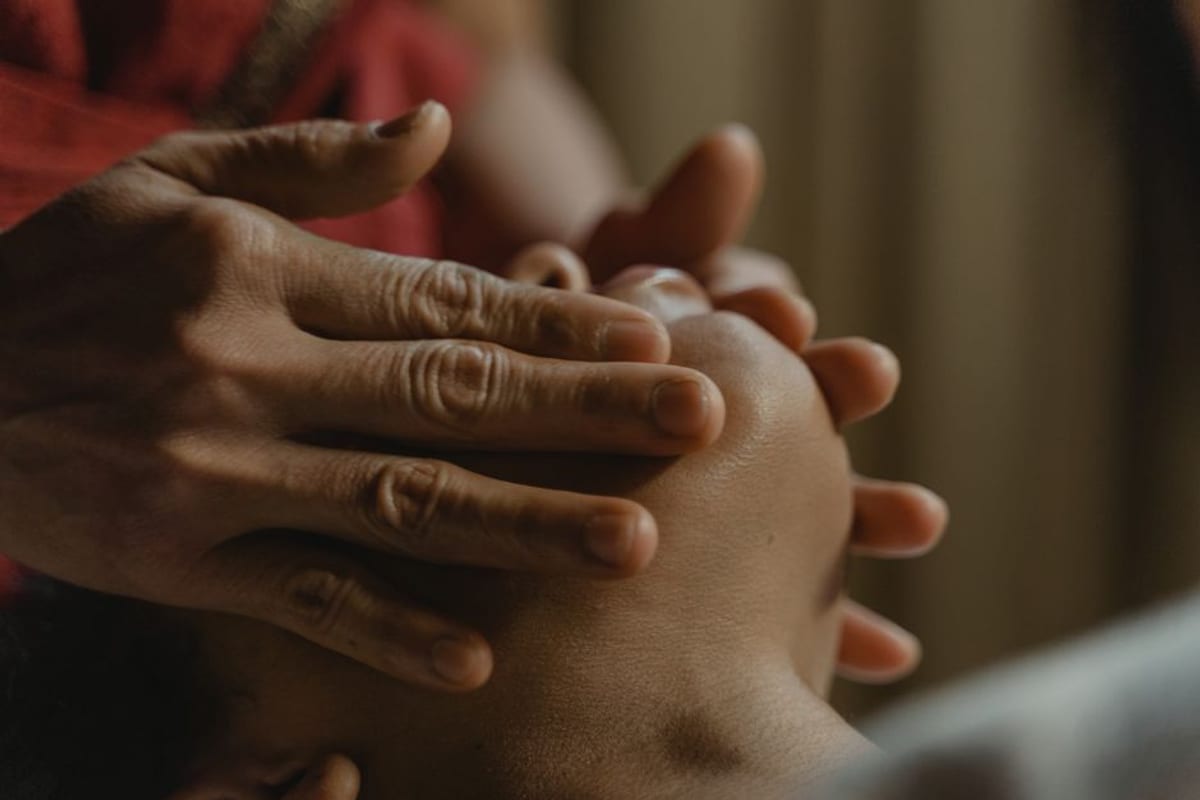
Lymphatic drainage sounds like something that requires a clinic and a qualification. The facial version is closer to the opposite: it works best with almost no pressure, needs no equipment, and takes about five minutes.
The catch is that it only works if you go in the right direction. Get that wrong and you’re just rubbing your face.
Where the fluid goes
Your lymphatic system has no pump. Blood has a heart pushing it around; lymph relies on movement, muscle contraction and gravity. That’s why it pools overnight while you lie still, and why your face looks different at 7am than it does at noon.
On the face, fluid drains toward clusters of lymph nodes in three places: under the jawbone, directly in front of the ears, and down both sides of the neck. Everything eventually heads down the neck toward the collarbone.
This gives you the only rule that really matters. Every stroke moves outward from the centre of the face, then downward. Toward the ear, then down the neck. Nothing goes up, nothing goes inward.
The neck comes first
Always. It’s the least interesting part and the one that decides whether anything else works.
Place flat fingers just below your ear. Stroke downward toward the collarbone, slowly, using barely any pressure at all. Repeat five to ten times each side.
The pressure here should feel almost pointless. Lymphatic vessels sit just under the skin, much shallower than muscle, and pressing hard compresses them shut. If you’re moving skin against the tissue underneath, you’re already pressing too hard.
Two minutes of this before touching the face. Every time.
With your hands
You don’t need a tool. Hands have an advantage a stone doesn’t: they warm up, they conform to the shape of your face, and they tell you what pressure you’re using.
Under the eyes. Ring fingers only, because they’re the weakest and you’ll naturally press less. From the inner corner outward toward the temple. Three passes, feather-light.
Cheeks. Flat fingers from beside the nose, angled up and out toward the top of the ear. Five passes each side.
Jaw. Knuckles or flat fingers from the chin along the jawbone toward the ear. Five passes.
Neck again. Same downward strokes as the beginning. This is what carries everything you’ve just moved down and away.
Total time is about five minutes. Do it on damp skin with a little oil or moisturiser so nothing drags.
With a stone
A gua sha stone does the same job with two differences: it stays cool, which feels good on puffy eyes, and its edge fits under the jawbone in a way fingers can’t quite manage.
Same directions, same order, same near-absent pressure. Hold the stone almost flat rather than on its edge.
For the under-eye area specifically, a stone or a chilled roller has a small real advantage. Cold constricts blood vessels, which reduces the look of puffiness on its own, separately from any fluid you move.
When you’ll see something
Immediately, if you’re going to see it at all. This isn’t a technique with cumulative results that appear in week six. Fluid moves during the session or it doesn’t.
The best time is the first hour after waking, when overnight retention is at its peak. That’s also when the difference is most visible, because you’re starting from the puffiest point of your day.
The effect lasts hours, not days. Fluid returns. That’s what fluid does.
Things that undo it faster than you can massage
Worth knowing, because they matter more than technique:
- Salt the night before. The single biggest lever on morning puffiness for most people.
- Alcohol. Dehydration and inflammation together.
- Sleeping flat. An extra pillow lets gravity help overnight instead of working against you.
- Not moving. Walking does more for lymphatic flow across your whole body than any facial technique.
- Not drinking enough water. Mild dehydration makes the body hold onto fluid.
If your face is puffy every single morning, the answer is more likely in this list than in your stroke technique.
When to skip it
Don’t do this over active infection, inflamed acne, or unexplained swelling.
Swelling on one side only, swelling that doesn’t settle during the day, or a lump you can feel under the jaw that wasn’t there before are all reasons to see a doctor rather than reach for a stone. Lymph nodes swell for reasons that have nothing to do with sleep or salt, and massaging them is not the answer.
What this doesn’t do
It doesn’t detoxify anything. Your liver and kidneys handle that, and they don’t need help from your fingertips. “Flushing out toxins” is marketing language attached to a real mechanism that does something more modest.
It doesn’t change your face shape. Fluid reduction reveals the shape underneath. That’s not the same as altering it.
It doesn’t last. By evening you’re roughly back where you started, which is fine, since you’ll do it again tomorrow.
It doesn’t need to be bought. The full routine works with your hands and thirty seconds of learning the directions. Everything sold for this is optional, and that’s worth saying out loud on a site that also writes about the tools.